Search
Cohort 1
Ecosystem Restoration and Regenerative Agriculture in Kakamega (Green Villages Int.)
Transformative Project for Ecosystem Restoration and Regenerative Agriculture in Kakamega
Location: Kakamega County, Ikolomani Subcounty, Idakho North Ward
Due to high poverty levels in certain sections of Kakamega County, Kenya, community members have resorted to tree felling as a primary means of income generation, primarily through the sale of firewood, charcoal production, and other commercial activities. Unfortunately, this unsustainable practice has resulted in the depletion of riparian lands, severely affecting critical ecosystem services. One significant consequence has been a notable reduction in water volumes across all springs in the area, with many now only flowing seasonally. Moreover, the loss of trees from these catchments contributes to climate change by releasing stored carbon into the atmosphere and diminishing the Earth's capacity to absorb CO2. Additionally, the absence of trees leads to reduced moisture release into the atmosphere, potentially disrupting local and even regional weather patterns. This moisture deficit in barren farmlands has also contributed to declining soil quality, with detrimental implications for local food security. Urgent intervention is imperative to mitigate this situation.
CJIFA gave a grant of EUR 7000 to Green Villages International (GVI), a local NGO set out to intervene through the adoption of a combination of the best practices (a.) Sustainable Agriculture Land Management (SALM) and (b.) Community Input Support System (CISS) implemented within self-organized eco-villages (Green Villages)—run by respective community members that promote voluntary leadership. GVI delivered this through activities including:
- Mobilization and widespread awareness raising of members on causes of environmental degradation and its effects on household’s livelihoods;
- Mapping and training of on-farm and non-farm actors’ ecosystem restoration and regenerative farming practices; and
- Establishing viable community structures to coordinate long-term responsible exploitation of trees in the catchments.
GVI collaborated with various key stakeholders, including the County Government of Kakamega, Equity Bank, Water Resource Users’ Association, Kenya Forestry research Institute (KEFRI), Kenya Forest Service (KFS), and National Environmental Trust Fund (NETFUND), to carry out the project. Each organization played a specific role in its implementation:
- The County Government of Kakamega provided crucial policy support and oversight.
- Equity Bank facilitated the establishment of an aggregation center, centralizing marketing efforts for the community.
- The Water Resource Users’ Association contributed expertise in managing water resources and conservation efforts.
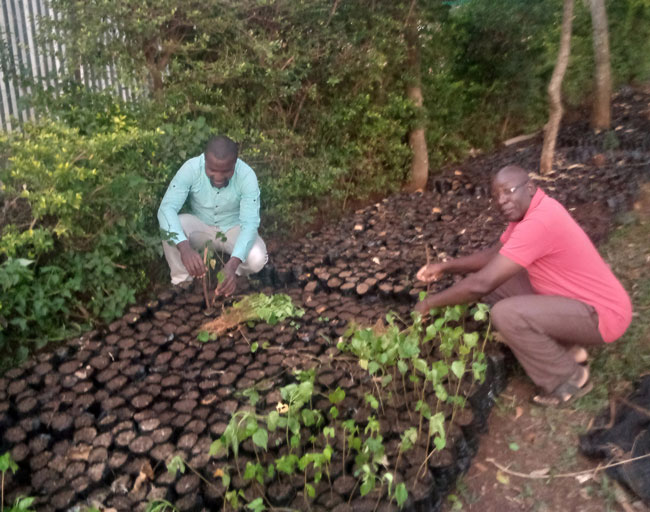
- KEFRI and KFS brought their extensive knowledge in forestry and environmental conservation to the project. They also trained GVI nursery managers on Nursery Establishment and management.
- NETFUND provided additional financial resources and support to bolster the initiative.
Together, these organizations also collaborated on the creation of a community input-saving scheme, which improved access to essential agricultural resources for community members involved in the project.
Early achievements encompass:
- Training sessions conducted for 800 women, 102 men, 188 youth, and 5 Persons Living with Disabilities (PLWDs).
- Secured commitment from the County Government of Kakamega to provide 100 bee hives.
Some of the early outcomes include;
- Increased awareness on the community role in restoration protection and conservation of natural spring water,
- Increased the willingness to establish soil and water conservation structures,
- Local led structures established facilitated collective efforts in the restoration and sustainable utilization of community natural resources and assets,
- Improved Linkages to partner institutions, credit support, skills in soil sampling, and value addition technologies.
- Increased awareness and demand for use of energy saving devices for cooking,
- Increased awareness on planting of indigenous tree species.
The trained groups were initiating the implementation of their respective initiatives. With the continuation of a supportive environment, marked by strengthened partnerships, these efforts anticipated to yield even more significant outcomes. Through the amalgamation of SALM and CISS practices, farmers and land managers aspire to strike a harmonious balance between agricultural productivity, climate and ecosystem resilience, leading to enhanced livelihoods and widespread adoption of sustainable practices within the eco-villages.
Key early lessons learned from this project include:
- Engaged with Existing Leadership: Identified community leaders, showed them their appreciation for their roles, and educated them about the CBO’s initiatives. Building a positive relationship with the leaders fostered their unconditional support and collaboration.
- Tapped into Community Knowledge: The community often understands its own challenges and potential solutions. The CBO guided them in the right direction, and the community found it easier to accomplish their objectives by harnessing their insights and expertise.
- Promoted Volunteering: In roles that aren't compensated with salaries, the CBO encouraged individuals to volunteer. Volunteers tend to be highly motivated and effective, so providing opportunities for such people to step into these positions was beneficial to projects and initiatives.