
In Cameroon’s South West Region, smallholder farmers are facing a changing climate that is making it harder to grow food and sustain their livelihoods.
In communities across Fako Division, farmers are experiencing erratic rainfall, prolonged dry spells, flooding, rising temperatures, declining soil fertility and increasing crop pests and diseases. These changes are affecting productivity, household food security and incomes.
Women and young farmers are among those facing the greatest challenges. Many have limited access to land, agricultural inputs, finance, extension services and timely climate information, leaving them more exposed to climate-related shocks.
Responding to these challenges, the Alliance for Sustainable Development (ASDEV), a Cohort 5 sub-grantee of the Climate Justice Impact Fund for Africa (CJIFA), is working with farming communities in Fako Division to strengthen their resilience through climate-smart agriculture.
The initiative, Building Resilience: Climate-Smart Agriculture for Sustainable Livelihoods in Buea, Fako Division, Cameroon, is putting farmers at the centre of the response.
Before the initiative began, many farmers had limited knowledge of climate-smart agricultural practices. The baseline assessment found very low knowledge and use of practices such as drought-tolerant seeds, composting, agroforestry, cover cropping and climate-smart planting basins.
ASDEV's approach has been to start with the communities themselves.
Farmers, community leaders, agricultural extension officers, researchers and other local stakeholders helped identify the challenges affecting agricultural production and the knowledge and support farmers needed.
The result is an approach shaped by local realities rather than a one-size-fits-all solution.
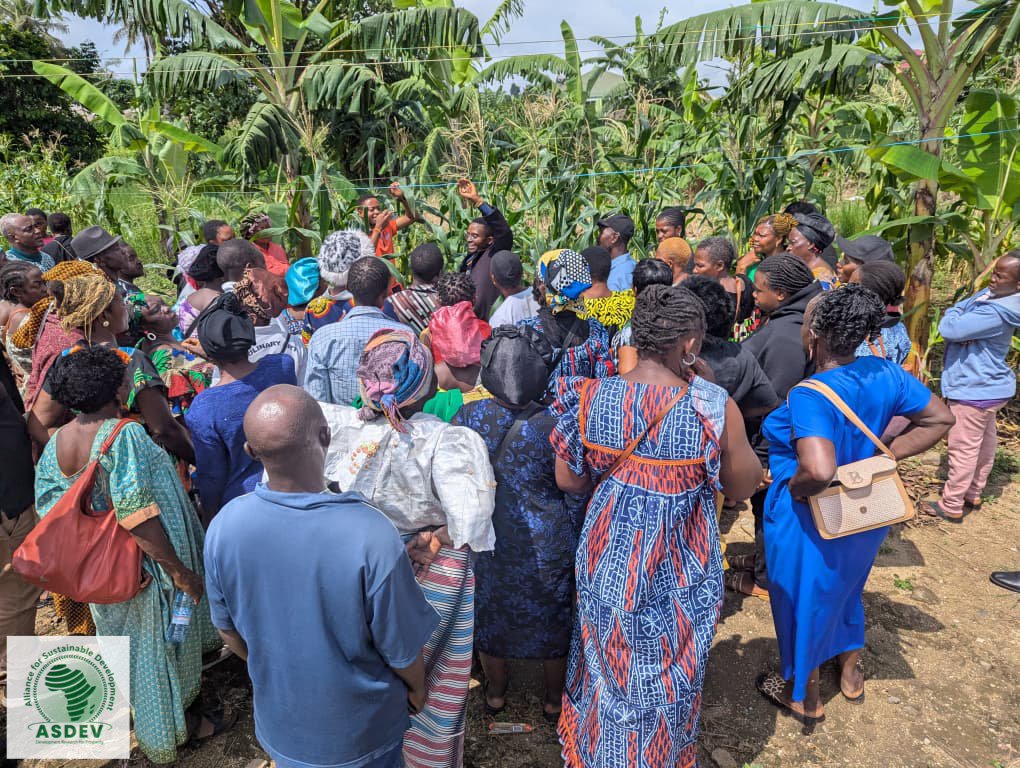
Farmers are receiving practical training and participating in field demonstrations on climate-smart agriculture. They are learning about drought-tolerant and early-maturing seeds, mulching, composting, crop rotation, agroforestry, minimum tillage, intercropping, water harvesting and other practices that can help them respond to climate pressures.
The action does not end when the training sessions are over.
Through a dedicated WhatsApp advisory platform, farmers continue to engage with agricultural extension officers, researchers and technical experts. They can raise challenges from their farms, share experiences and receive advice as they put new practices into use.
This is locally led climate action in practice.
Farmers are not simply recipients of an intervention. Their experiences, knowledge and priorities are helping shape the response, while local institutions and technical partners provide the support needed to strengthen community action.
The initiative is also bringing together farmers' existing knowledge with new agricultural approaches. Their understanding of local soils, rainfall patterns and farming systems is being combined with improved seed technologies and climate-smart practices suited to local conditions.
So far, 215 smallholder farmers across Fako Division have directly benefited from the training, field demonstrations and continued advisory support.
For farmers, the change is already visible in increased knowledge and confidence to make more informed decisions about their farms.
Ketchem Rudolph, a young farmer from Muea village, says the training has given him the skills and knowledge to cultivate more sustainably.
Another farmer, Etonjoh Anna Etoh from Wotutu village, says the training helped her better understand planting basins, a practice she had used before without fully understanding its benefits. She now plans to apply the knowledge during the coming farming season.
The initiative is still at an early stage, with farmers preparing to apply many of the practices during the coming farming season. Its emerging impact is therefore not only about immediate changes in agricultural production, but about building the knowledge, confidence and local capacity needed for longer-term resilience.
This is the kind of climate action that the Climate Justice Impact Fund for Africa seeks to support.
CJIFA invests in locally led initiatives that are often closest to communities, closest to the problem and best placed to understand what solutions can work in their own context.
These are the actions that can easily remain unfunded despite their importance.
By supporting organisations such as ASDEV, CJIFA is helping move resources and decision-making closer to the communities living with the realities of climate change.
In Fako Division, that support is helping farmers turn local knowledge into climate action, strengthen their resilience and take greater ownership of their response to a changing climate.